 Palm Desert Sliding Glass Door Repair
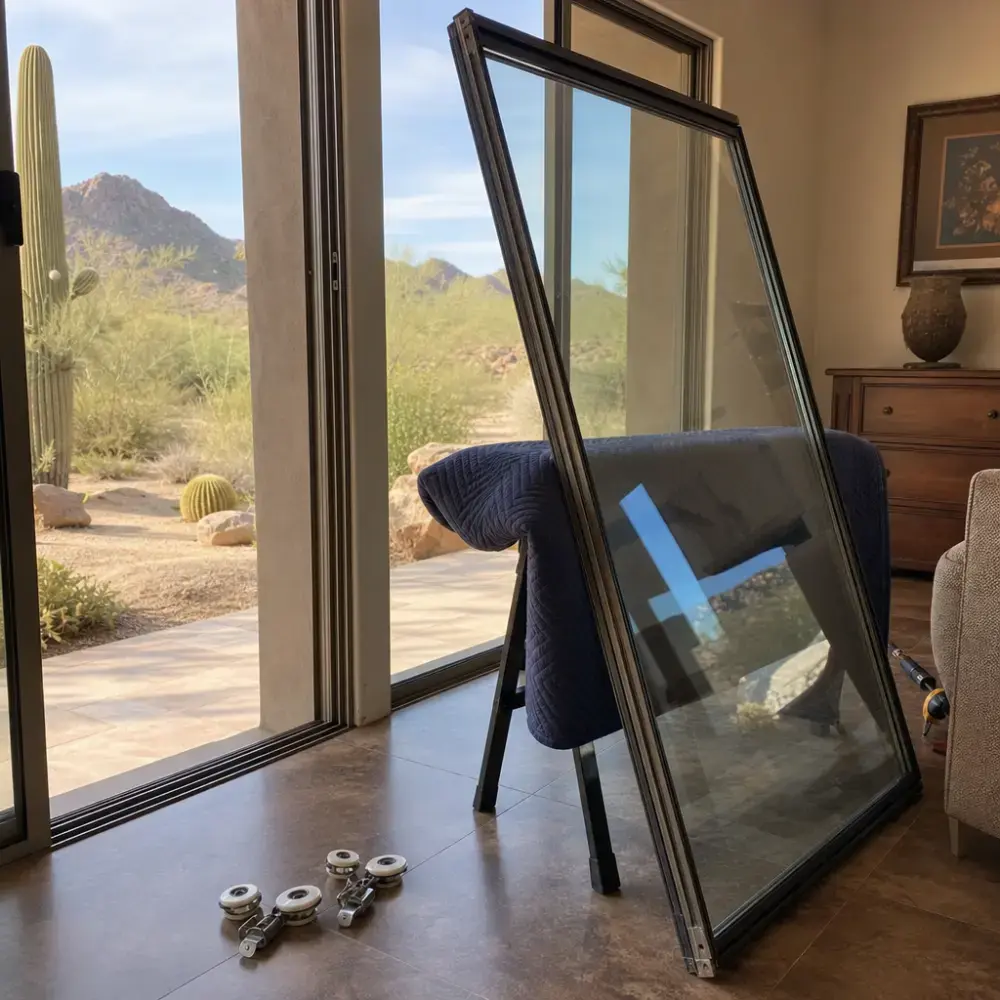
We fix sliding glass doors where they hang, at houses, condos, and casitas across Palm Desert and the rest of the Coachella Valley. Typical jobs: $175 to $375 for roller replacement, $150 to $300 for a stainless track cap, $100 to $300 for a lock or handle, $100 to $250 for new weatherstrip and dust seals, and $350 to $950 per panel for a fogged or cracked dual-pane unit. When a door is truly finished, a standard two-panel replacement runs $1,800 to $4,500. Send us a photo of the door and a close-up of the bottom track and we will tell you what it most likely needs and what it should cost.
A sliding door is a heavy glass panel balanced on two small wheels. In this valley those wheels live in a track that collects blowing sand, under sun that heats the frame well past what the hardware was ever tested at in a showroom. That combination wears doors out in a particular order, and almost every step of it is a repair.
What we repair
- Roller replacement: seized, flat-spotted, and sand-packed rollers swapped for sealed-bearing wheels rated for the panel, then the door re-hung and adjusted so it glides and the lock lines up.
- Track repair and replacement: bottom rails scored by sand under a skidding wheel, worn flat, or bent, cleaned and capped in stainless or replaced in the frame.
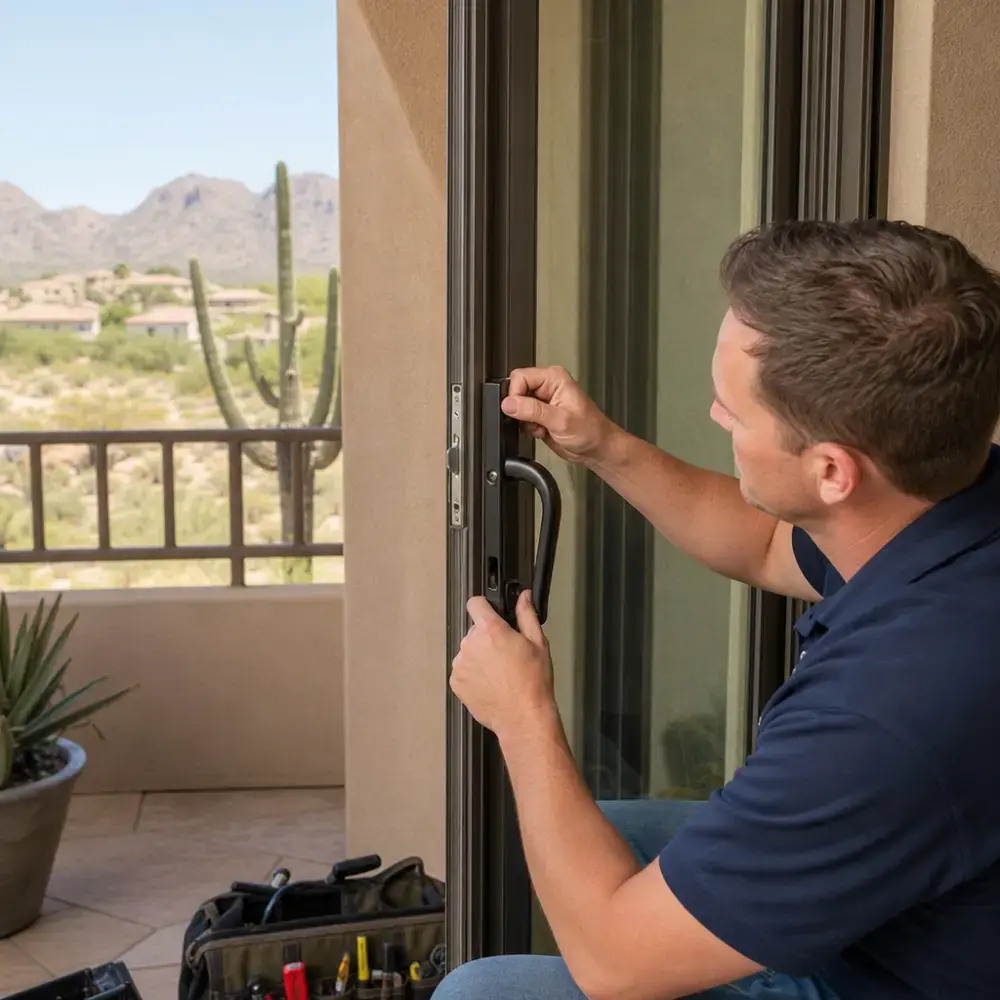
- Locks and handles: mortise locks that stopped catching, cracked handle sets, worn keepers, and secondary foot locks.
- Glass and seal replacement: fogged and cracked insulated units replaced in your existing panel with tempered, low-E glass.
- Weatherstrip and dust seals: sun-baked pile, interlock seals, and sweeps replaced so the next wind event leaves the sand on the patio.
- Screen door repair: rescreens, solar screen mesh, rollers, and new screen doors.
- Full sliding door replacement: a new door measured to the opening, specified for the valley’s energy code, set, sealed, and trimmed.
Why desert sliding doors wear out the way they do
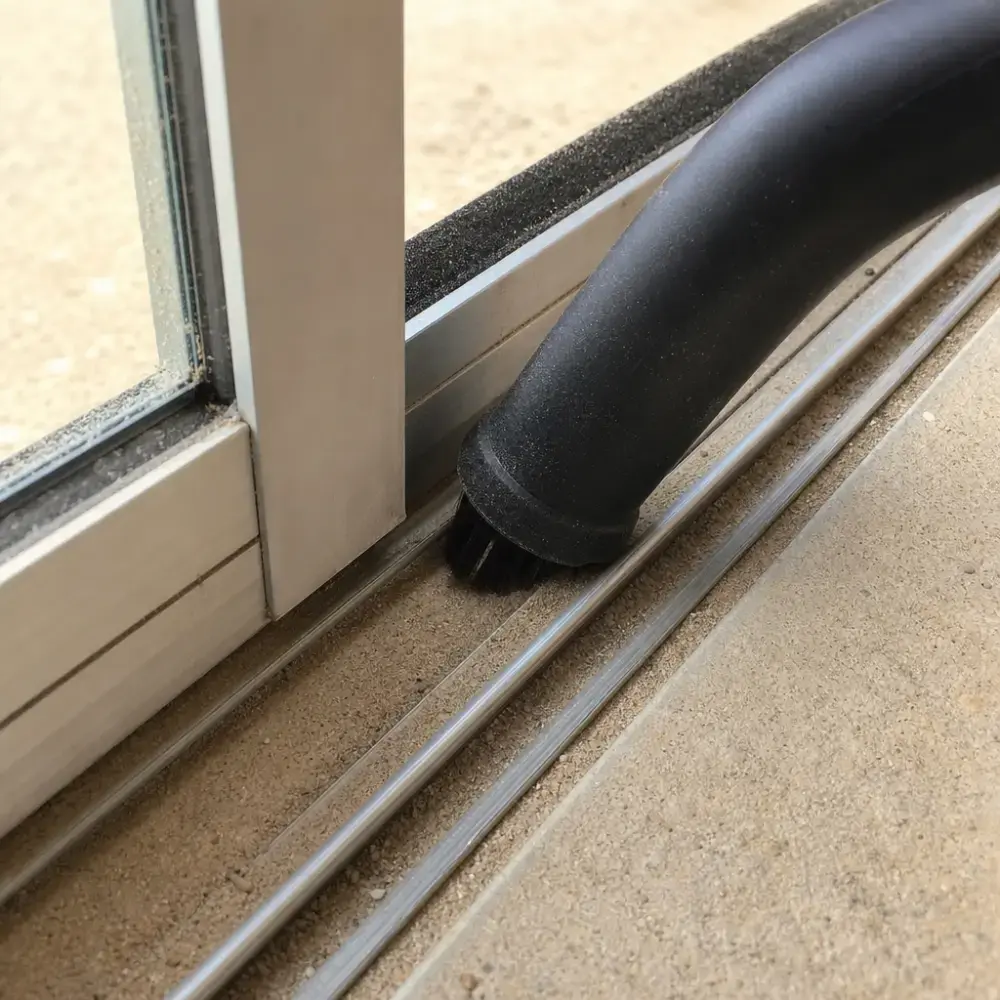
Sand comes first. The Coachella Valley is a wind corridor. Sand that washes down the drainages in flood years is spread across the valley floor by the steady winds pouring out of the San Gorgonio Pass, and California’s Department of Fish and Wildlife describes the remaining loose “blowsand” running in patches from the pass southeast to Indio. The San Gorgonio Pass Wind Farm sits at the head of that corridor for a reason: it is one of the most consistently windy places in the country. When the South Coast Air Quality Management District issued a windblown dust advisory in April 2026, it forecast gusts to 43 mph in the northern valley and 50 to 60 mph in the pass, and told residents to stay in with windows and doors closed. Every one of those days loads the bottom track of every slider in the valley. Fine sand under a roller is grinding compound. The bearings bind, the wheel skids, the rail gets scored, and the door that slid with a finger in March needs a shoulder by June.
Heat works on the glass and the seals. Palm Springs averages a high of 108.6 degrees in July and about 115 days a year at or above 100, by the NOAA normals, and its airport set an all-time record of 124 degrees on July 5, 2024. Window industry writers name exactly what that does to a dual-pane unit: direct sun degrades the seals and spacers, and daytime heating followed by night cooling makes the panes expand and contract until the seal softens and lets go. That is the fog you see between the panes, and it shows up first on doors facing south and west. The same sun bakes vinyl and rubber weatherstrip until it shrinks and cracks.
Doors sit closed for months. In the 2023 Census estimates, 28 percent of Palm Desert’s homes were held for seasonal or occasional use, and Rancho Mirage and Indian Wells run higher still. A slider that stays shut from May to October in a hot, closed-up house comes back in the fall with dry rollers, a lock that does not want to turn, and a summer of dust packed into the track. We cover that in what to do with your doors when you close up for summer.
The valley’s doors, house by house
- Palm Desert’s 1970s and 1980s stock. More than half of Palm Desert’s homes were built between 1970 and 1989, and about 30 percent are attached homes such as condos and townhouses, in a city that counts around thirty golf courses. These are the original aluminum and early vinyl sliders, now on their second or third set of rollers if they have had any at all.
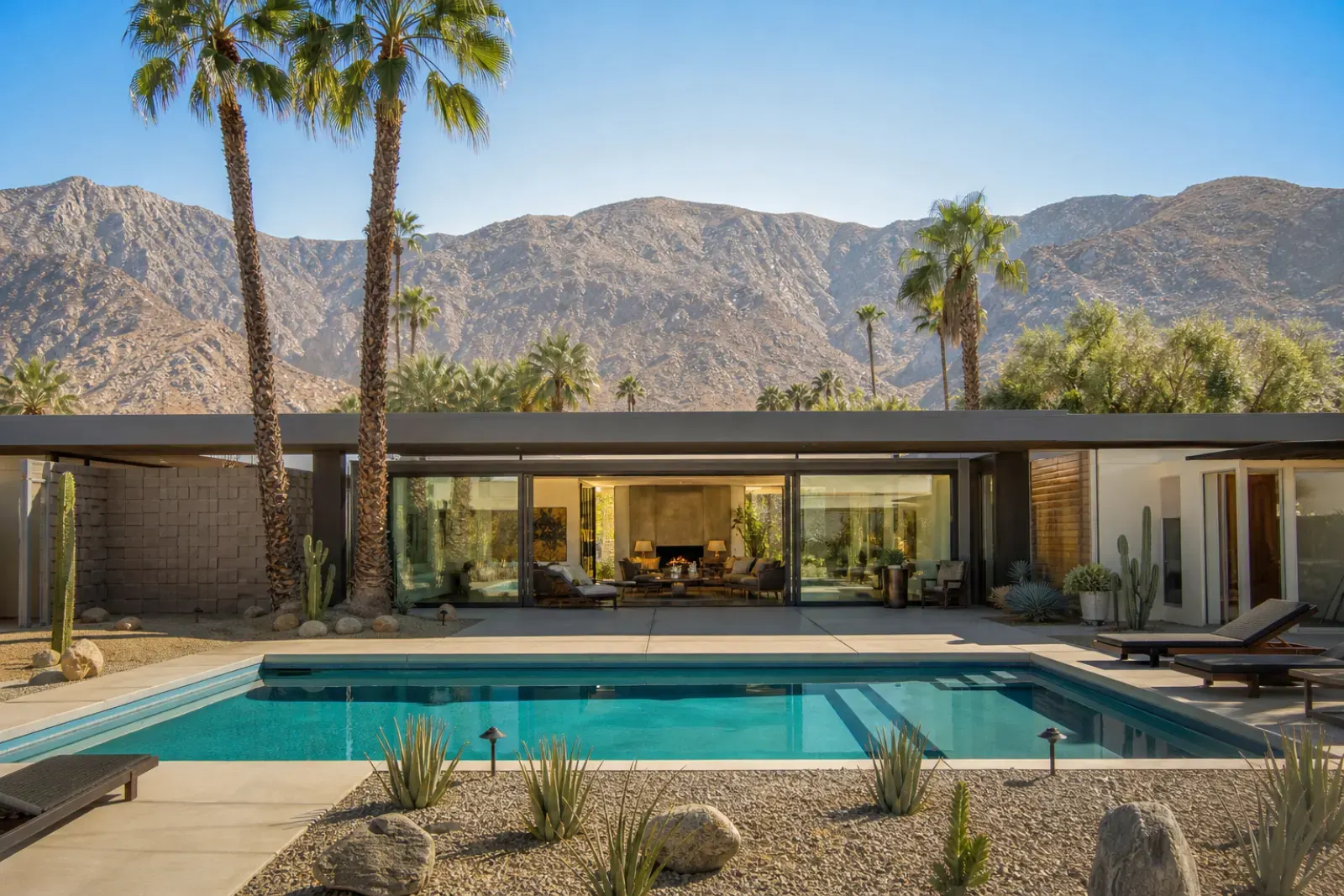
- Mid-century modern Palm Springs. The Alexander Construction Company built more than 2,200 houses across the valley between 1955 and 1965, mostly to designs by Palmer and Krisel, and the major rooms in those houses were walled in floor-to-ceiling glass with sliding doors eight feet tall. Tall panels are heavy panels. They wear rollers faster, and they deserve a repair before anyone suggests tearing them out. See Palm Springs and our post on mid-century sliders.
- Country clubs and seasonal homes. Rancho Mirage’s clubs date from Thunderbird in 1950 onward, Indian Wells’ first courses opened in the 1950s, and La Quinta’s population grows by 20 to 50 percent from November to April. These doors get heavy use for half the year and none for the other half. See Rancho Mirage, Indian Wells, and La Quinta.
- Newer tracts on the east end. More than a third of Indio’s homes were built between 2000 and 2009. Their sliders are now about twenty years old, a long run for original rollers in desert sand. See Indio.
How a repair visit goes
- Photo triage. Tell us what the door does (drags, jumps, drops, will not lock, fogged, cracked, lets sand in), roughly how wide and how tall it is, and whether the fixed panel is on the inside or outside. A close-up of the bottom track tells us most of the rest.
- Panel out. We lift the sliding panel out of the track. On tall or heavy doors that is two people. With the panel out we can see the rollers, the rail, the interlock, and the head track, and we show you the old rollers.
- Rollers and track. New sealed-bearing rollers go in, matched to the housing and rated for the weight. If the rail is scored, it gets a stainless cap or a new track, because new wheels on a rough rail wear out fast.
- Lock, seals, and adjustment. We set the roller height so the panel is plumb and the lock meets the keeper, replace worn pile and interlock seals, clean the track, and lubricate it dry. Grease and oil hold sand against the wheels, so they do not go anywhere near a desert track.
- Glass and new doors. Fogged or cracked units are measured and ordered, then set into your panel on a second visit. A door past saving is measured for a replacement that meets the energy rules for this climate zone.
Typical pricing
| Repair | Typical range |
|---|---|
| Service call | $95 to $175 |
| Roller replacement, per door | $175 to $375 |
| Stainless track cap / full track replacement | $150 to $300 / $300 to $650 |
| Lock, handle, or keeper | $100 to $300 |
| Weatherstrip, interlock, and dust seals | $100 to $250 |
| Insulated glass unit, per panel | $350 to $950 |
| Screen door (rescreen to new door) | $75 to $450 |
| Full replacement, standard two-panel | $1,800 to $4,500 |
The pricing page explains what moves each number, including the 8-foot-tall and multi-panel doors that sit above these ranges. The repair cost estimator turns the table into a number for your door, and the problems pages start from the symptom if you are not sure what is wrong.
Codes, permits, HOAs, and who can do what
California’s energy code treats a sliding glass door as fenestration. A replacement in the valley has to meet the rules for Climate Zone 15, the extreme desert zone, whose reference weather station is Palm Springs airport. Under the 2025 code, in effect since January 1, 2026, the prescriptive target for replacement glazing in Zone 15 is a U-factor of 0.30 and a solar heat gain coefficient of 0.23, with a looser 0.40 and 0.35 allowed when the replaced area is 75 square feet or less. Glass in a sliding door panel is also a hazardous location under the California Residential Code, which means safety glazing (in practice, tempered glass) carrying a permanent manufacturer’s mark. Repairs that keep your existing panel do not change any of that. Our permits and Title 24 guide goes city by city.
On licensing: since January 1, 2025, California lets an unlicensed person take only jobs under $1,000 in total, with no employees and no permit needed. A new door is larger than that and usually needs a permit, so it needs a licensed contractor, and the classification written for glass and glazed doors is C-17. Ask for the license number on any replacement and look it up with the CSLB before work starts.
On HOAs: in a California condo or planned community the declaration decides who repairs and replaces doors, and where the governing documents require approval for a change, the association has to decide in writing, in good faith, under a procedure with set deadlines. A like-for-like roller job rarely needs approval. A new door with a different frame color or grid pattern often does. Our HOA approval post walks through it.
Where we work
We are centered on Palm Desert and cover the valley floor: Palm Springs, Cathedral City, and Desert Hot Springs to the west and north; Rancho Mirage and Thousand Palms next door; and Indian Wells, La Quinta, Bermuda Dunes, and Indio to the east. Homes anywhere between the pass and Indio are ours to cover.
Send a photo of the door, a close-up of the bottom track, and a line about what it is doing. You will get a likely diagnosis and a number from the ranges above, and we will bring the right parts the first time. Questions first? Try the FAQ or read about us.